Light that behaves like light
The live editor stays responsive with screen-space lighting and short idle refinement. When you ask for a final frame, the full tracer converges tile by tile with no render farm or export queue. The whole pipeline runs in the tab.
The pipeline
Representation
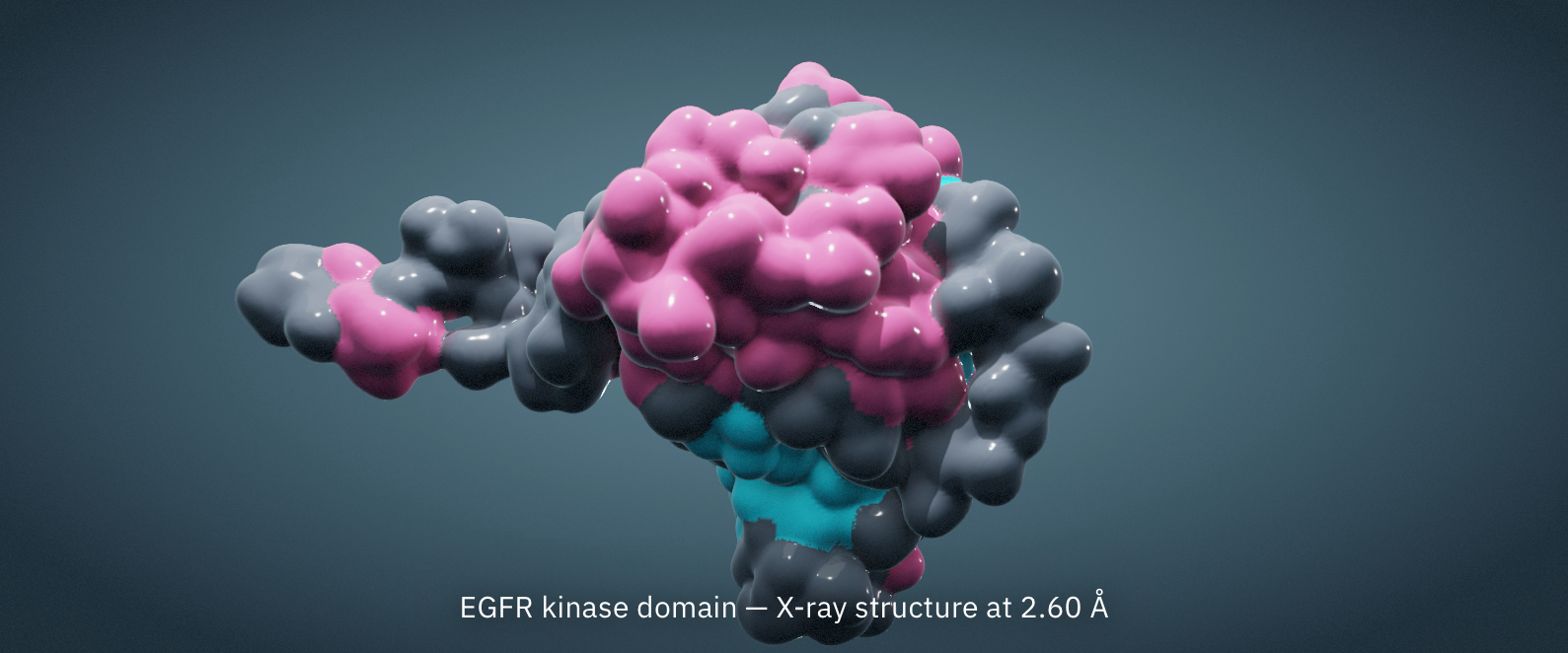
Molecular cartoons, solvent surfaces, atoms, sticks and mixed representations, layered per selection, so a ribbon, its pocket surface and a bound ligand coexist in one scene. Compare the editable T7 replication fork as a cartoon-led film or an actor-local molecular-surface film without changing its underlying mechanism.
Material
A packed 2K PBR atlas of 1K protein, membrane, ceramic and machined-metal families, projected in world space with seamless triplanar sampling. Molecules have no UVs and do not need them.
Light transport
For final renders, ray-traced shadows, ambient visibility, indirect light, and glossy reflection accumulate sample by sample. Each traced pass is explicitly enabled per project.
Surface response
Energy-conserving diffuse, subsurface, and clearcoat layers. Subsurface depth is thickness-driven and specified per material in ångströms, because that is the scale the light is working at.
Lens & colour
Depth of field, bloom and fog shape the frame, and AgX and ACES pipelines grade it. These are the controls a cinematographer would reach for, working at molecular scale.
Export
Tiled still export renders frames far larger than the screen, tile by tile, at figure and poster resolution straight from the tab. Labels, callouts and shot captions are controlled by an independent annotation switch, so the same project can produce an explained frame or a clean plate.
Atlas channels
Renderer-neutral by design: geometric signal in height, scan grain in roughness, recesses isolated as a true cavity mask.
Rebuild the atlas
A deterministic pipeline turns neutral material scans into perfectly repeating, mip-stable tiles.